


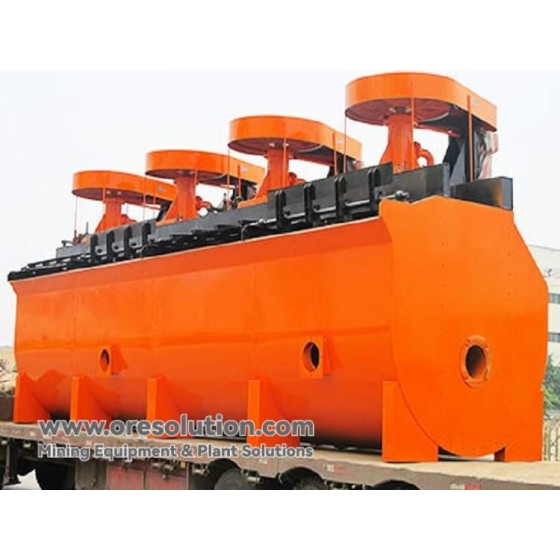
Barite Processing Plant: The Ultimate Beneficiation Guide for Drilling & Chemical Grades
Barite (Barium Sulfate, BaSO4) is a heavy, non-metallic mineral that quietly underpins several critical global industries. Over 80% of the world's barite production is consumed by the oil and gas sector. When crushed into a fine powder, it acts as a high-density weighting agent in drilling muds, preventing explosive "blowouts" when high-pressure gas reserves are struck. Beyond drilling, high-purity, bright-white barite is a highly prized filler in the paint, plastics, and medical (barium meal) industries.
The core challenge in a barite processing plant is that run-of-mine (ROM) barite rarely meets commercial specifications straight out of the ground. It is often intergrown with lighter gangue minerals like quartz, calcite, and shale, or contaminated with coloring agents like iron oxides and galena. The goal of the barite beneficiation process is simple but demanding: increase the Specific Gravity (SG) to the API (American Petroleum Institute) standard of 4.1 or 4.2, or increase the chemical purity to >95% BaSO4 for chemical grades.
As a leading global EPC (Engineering, Procurement, and Construction) contractor, OreSolution designs and commissions high-efficiency Barite Beneficiation Production Lines. This comprehensive engineering guide breaks down the physical and chemical separation strategies required to maximize recovery and profitability from any barite deposit.
The fundamental characteristic of barite is its weight (Specific Gravity of 4.5). Because typical waste rock (quartz/limestone) has a specific gravity of around 2.6, Gravity Separation is the most logical, environmentally friendly, and cost-effective method for concentrating barite. Complex flotation is only required when the ore is extremely fine-grained or requires exceptional chemical purity.
Part 1: Understanding Commercial Barite Grades
Before designing the comminution and separation circuits, you must define the end product. The market for barite is segmented into two primary categories, each with distinct processing requirements.
Part 2: Comminution - The Crucial Crushing Strategy
Barite is remarkably soft (Mohs hardness of 3 - 3.5) and friable (brittle). If subjected to aggressive grinding, it will quickly pulverize into ultra-fine "slimes." While final drilling grade barite must be a fine powder, over-grinding *before* separation makes gravity recovery nearly impossible.
OreSolution's "Crush More, Grind Less" Approach:
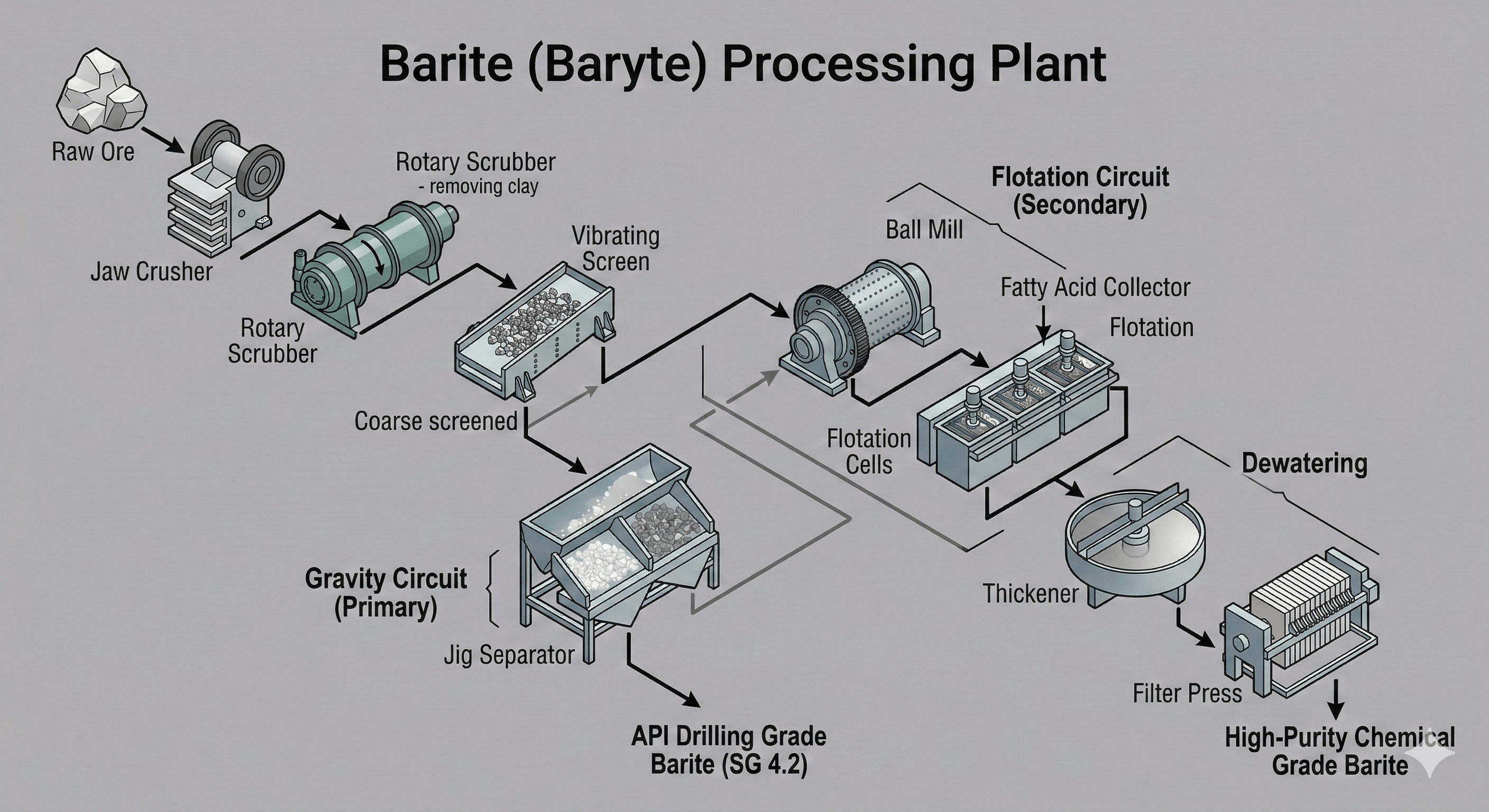
- Primary Crushing: Run-of-Mine ore is fed into a Jaw Crusher for coarse reduction.
- Secondary Crushing: A Cone Crusher or Fine Jaw Crusher is used to bring the ore down to a suitable size for gravity separation (typically -15mm to -30mm).
- Washing and Desliming: Many barite deposits contain sticky clay. Passing the crushed ore through a Rotary Scrubber removes the clay, preventing screens and Jigs from blinding, and instantly improving the overall grade.
Part 3: Gravity Separation - The Heart of Barite Beneficiation
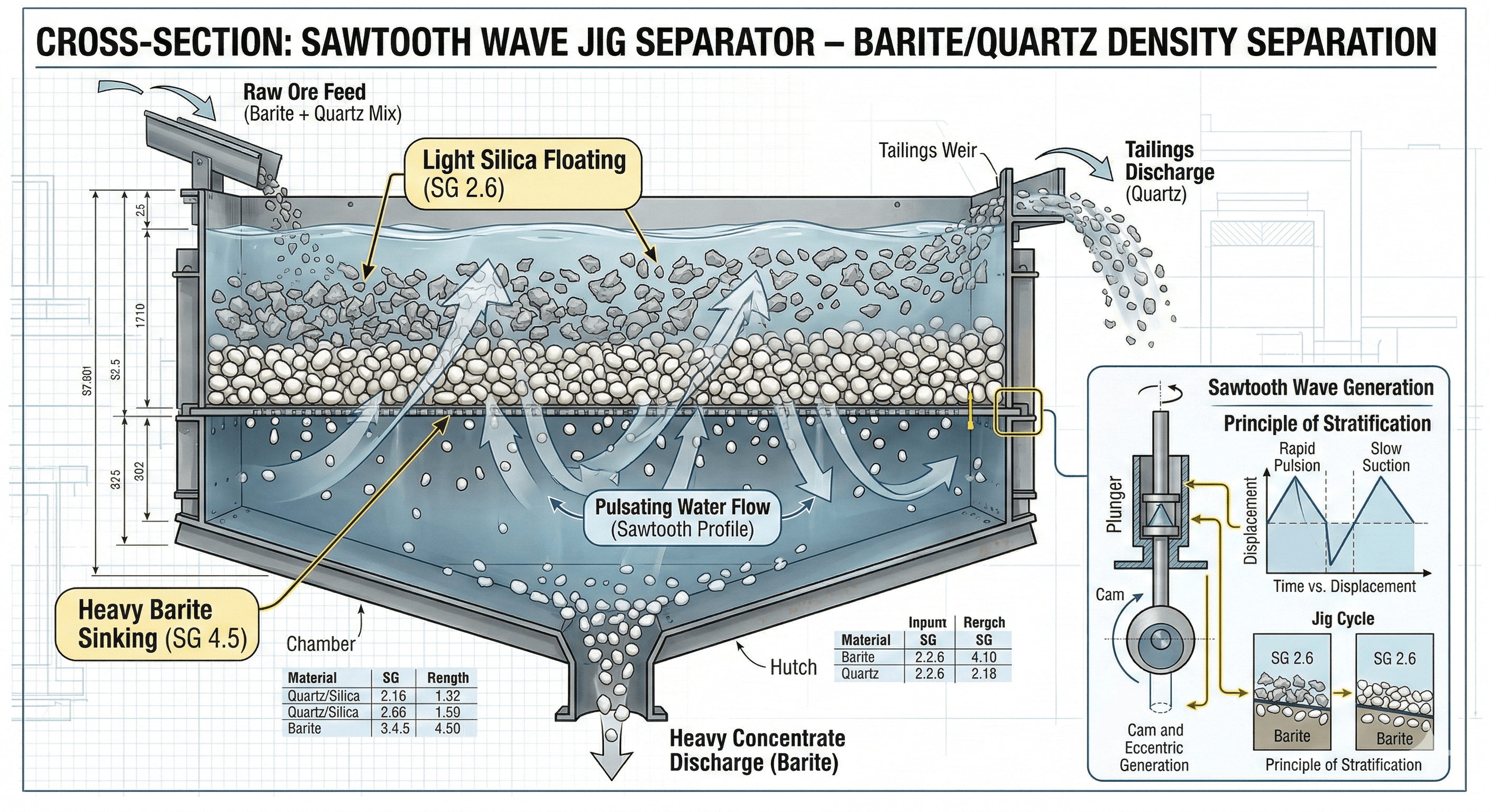
Because of the large density difference between barite (SG ~4.5) and gangue (SG ~2.6), a modern barite processing plant relies heavily on multi-stage gravity separation.
The Golden Rule: If the barite crystals are large and distinct from the quartz, a simple crushing and Jigging plant is often sufficient to produce API drilling grade barite.
Part 4: Barite Flotation - When Gravity Isn't Enough
While gravity is preferred, Froth Flotation becomes mandatory under specific conditions:
- The barite is finely disseminated (interlocked) within the waste rock, requiring grinding to -200 mesh for liberation.
- The target product is high-purity Chemical or Paint Grade (>95% BaSO4, high whiteness), which gravity alone cannot consistently achieve.
- The ore contains associated valuable sulfide minerals (like Galena/Lead or Sphalerite/Zinc) that must be recovered separately.
The Flotation Chemistry
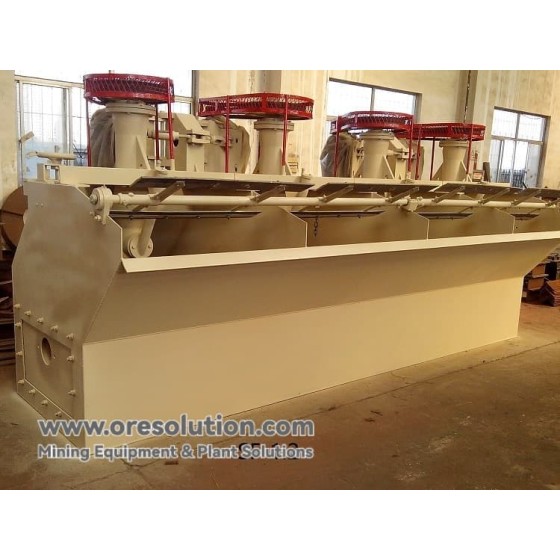
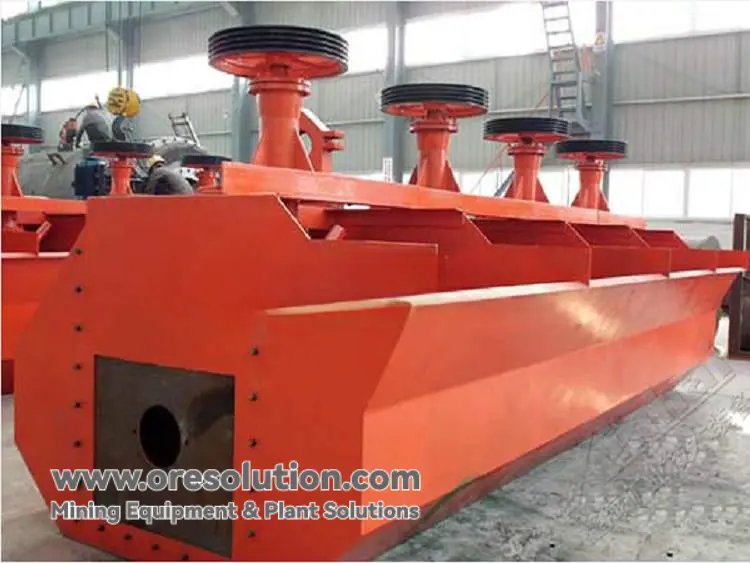
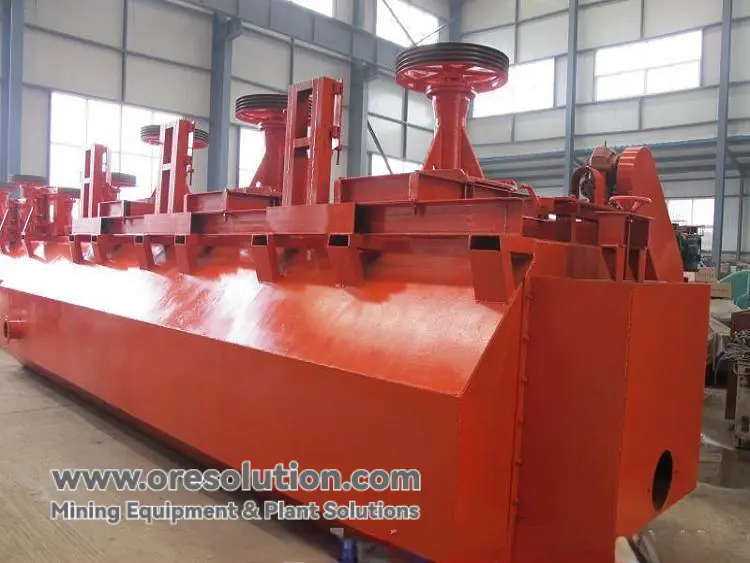
Barite flotation requires precise chemical control, typically utilizing Air-Inflated Flotation Machines.
- Collectors: Fatty acids (like Oleic Acid) or petroleum sulfonates are commonly used to make the barite surface hydrophobic.
- Depressants: Sodium Silicate (Water Glass) is critical for depressing quartz and silicate gangue. If calcite is present, specialized depressants must be formulated.
- pH Control: Flotation is typically performed in a slightly alkaline environment (pH 8.5 - 9.5) using Sodium Carbonate.
Complex Ores: If the barite ore contains Lead (Galena), the standard procedure is Sequential Flotation. First, float the Lead using Xanthate collectors while depressing the barite. Then, take the tailings, change the chemistry to fatty acids, and float the Barite.
Part 5: Upgrading Whiteness - Magnetic Separation and Bleaching
For Paint Grade or Medical Grade barite, physical separation is only half the battle. The product must be exceptionally white.
- Magnetic Separation: Iron oxides (limonite, hematite) often stain barite reddish or brown. Passing the dried barite concentrate through a High-Intensity Dry Roll Magnetic Separator can effectively pull out these weakly magnetic impurities, instantly improving whiteness.
- Acid Bleaching: If the iron staining is deep within the crystal structure, chemical bleaching using sulfuric acid or hydrochloric acid is required. This converts insoluble iron into soluble salts that are washed away. This is a high-OPEX process reserved for premium grades.
Part 6: Dewatering and Final Preparation
Whether produced via Jigs or Flotation, the final barite concentrate is wet. Because drilling mud requires a dry powder, dewatering is essential.
The slurry is sent to a High-Efficiency Thickener for initial concentration, followed by a Plate and Frame Filter Press or Vacuum Filter. The resulting filter cake is then dried in a Rotary Dryer. Finally, for drilling applications, the dry barite is milled to a fine powder (typically using a Raymond Mill) before bagging.
FAQ: Troubleshooting Barite Processing Plants
A: Poor Jig performance usually stems from two issues: 1) Poor sizing. A Jig requires a narrowly sized feed (e.g., 5-15mm or 15-30mm). If you feed it a mix of large chunks and fine dust, it cannot stratify properly. Install a vibrating screen before the Jig. 2) Stroke adjustment. Ensure the stroke length and frequency of the Sawtooth Wave Jig are properly tuned to the specific gravity of your ore.
A: If gravity separation (Jigging) isn't reaching SG 4.2, it means the barite is still locked with lighter silica. You must implement a "Grind and Float" strategy. Grind the Jig middlings or tailings finer (using a Ball Mill) to liberate the remaining barite, and then process it through a flotation circuit or Shaking Tables.
A: Fatty acid collectors (like Oleic acid) are powerful but tend to create highly stable, tough froths, especially in cold water. To improve selectivity and froth manageability, you can heat the slurry slightly, optimize the Sodium Silicate dosage to ensure gangue is fully depressed, or use a customized oxidized paraffin soap collector.
Conclusion: The OreSolution EPC Advantage
Designing a profitable barite processing plant requires a delicate balance between CAPEX, OPEX, and the stringent demands of the API or chemical markets. Defaulting to expensive flotation when a simple gravity circuit would suffice destroys profitability. Conversely, relying solely on Jigs for finely disseminated ore will fail to produce commercial-grade SG.
At OreSolution, we let the ore dictate the flowsheet. From conducting detailed sink-float and flotation tests in our laboratory to manufacturing robust Sawtooth Wave Jigs and advanced Flotation cells, we deliver turnkey Barite Production Lines that guarantee the specific gravity and purity your buyers demand.
Are you developing a Barite deposit for the drilling or chemical industry? Contact OreSolution today to consult with our senior process engineers and design your optimal beneficiation plant.