


Lithium Beneficiation Process: The Ultimate Guide to Spodumene Processing Plants
The global energy transition has crowned Lithium as the "White Petroleum" of the 21st century. With the EV market projected to triple by 2030, the demand for battery-grade lithium carbonate and hydroxide is insatiable. While brine deposits exist, hard rock lithium (Spodumene) is increasingly favored by miners for its higher processing speed and reliability.
However, designing a successful spodumene processing plant is technically demanding. The mineral's density (SG 3.1-3.2) is frustratingly close to gangue minerals like Quartz (SG 2.65) and Feldspar (SG 2.6). This makes the lithium beneficiation process a complex engineering challenge requiring precise flowsheets.
As a global Lithium Ore Production Line EPC provider, OreSolution helps investors navigate the critical choice between Dense Media Separation (DMS) and Lithium Flotation Process. This guide analyzes the technology, SC6 standards, and optimal flowcharts for a profitable plant.
Battery manufacturers demand low Iron (Fe2O3 < 0.8%) content. A plant that recovers high lithium but fails to remove iron produces a product that sells at a massive discount. Magnetic separation is not optional; it is mandatory in any modern lithium ore processing flow chart.
What is SC6.0 Spodumene? (SC6 Meaning)
Before diving into the machinery, it is crucial to understand the product goal. In the lithium industry, you will often hear the term "SC6" or "SC6.0". But what is the SC6 spodumene meaning?
SC6 stands for Spodumene Concentrate 6%. It refers to a processed ore concentrate that contains 6.0% Lithium Oxide (Li2O). This is the global benchmark grade required by chemical refineries (converters) to produce battery-grade Lithium Hydroxide or Carbonate.
- Raw Ore Grade: Typically 1.0% - 1.5% Li2O (Run of Mine).
- Target Product: SC6.0 (6.0% Li2O).
- Premium Grade: Low iron (<0.8% Fe2O3) and low mica content.
Achieving this 6% grade from a 1% feed requires a highly efficient lithium beneficiation process capable of rejecting over 85% of the mass as waste (tailings).
Lithium Ore Processing Flow Chart: An Overview
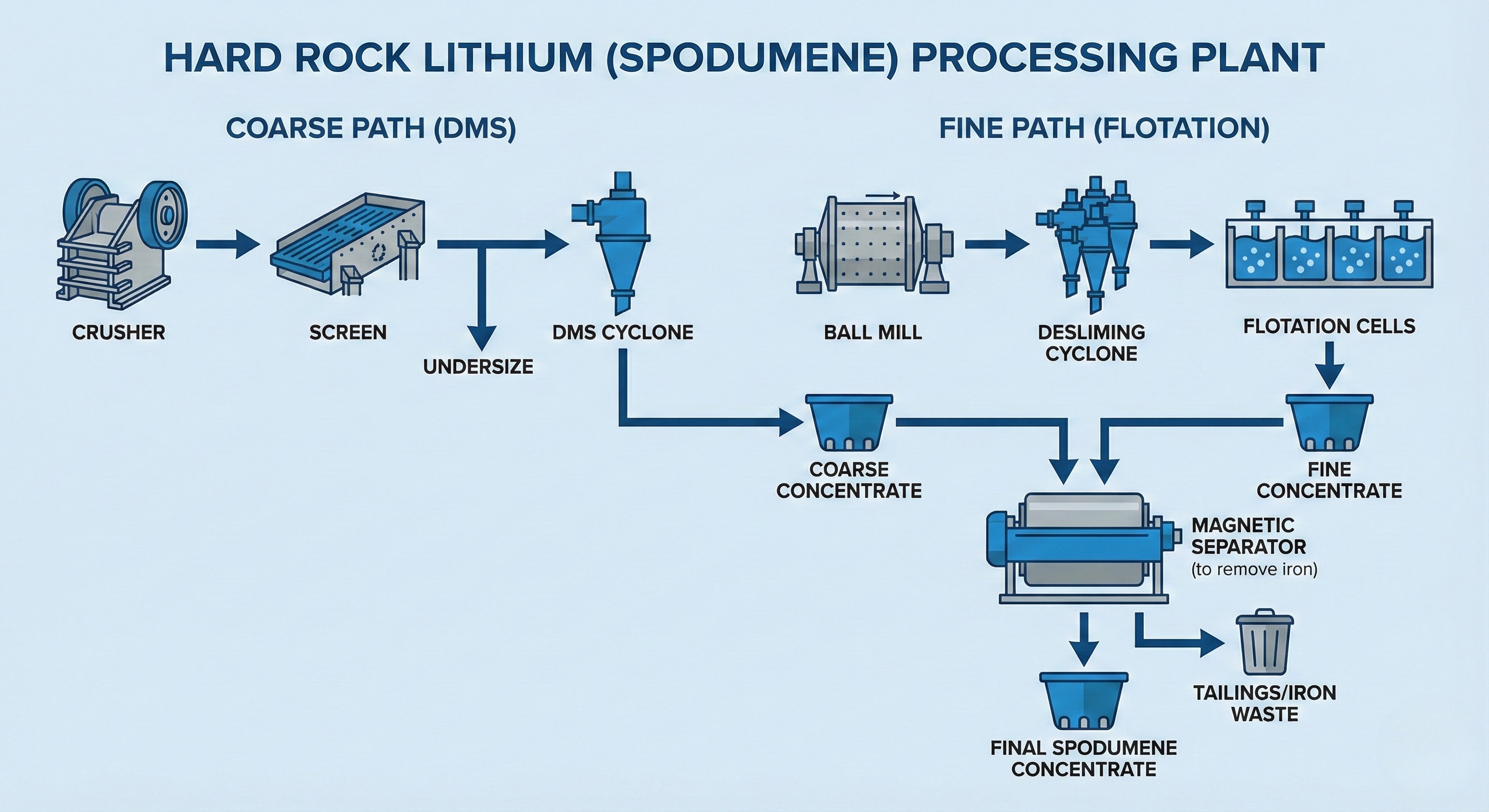
The spodumene processing plant generally consists of four critical stages. A well-designed lithium ore processing flow chart integrates these steps to maximize recovery:
- Comminution (Crushing & Grinding): Careful liberation without over-grinding.
- Dense Media Separation (DMS): Gravity separation for coarse particles.
- Froth Flotation: Chemical separation for fine particles.
- Magnetic Separation: Iron removal for final purification.
Step 1: Crushing & Grinding – The Importance of HPGR
Spodumene is brittle. If you crush it too fine using standard methods, it turns into "slime" (mud), which is notoriously difficult to recover in the lithium flotation process. Therefore, the crushing circuit must be designed to minimize fines generation.
Cone Crusher vs HPGR
Traditionally, plants used Cone Crushers. However, modern plants are shifting towards High Pressure Grinding Rolls (HPGR) for the tertiary crushing stage.
After crushing, the material is ground in a Ball Mill. It is critical to use a closed-circuit grinding system with Hydrocyclones to prevent over-grinding spodumene into non-recoverable slimes.
Step 2: Dense Media Separation (DMS) for Coarse Lithium
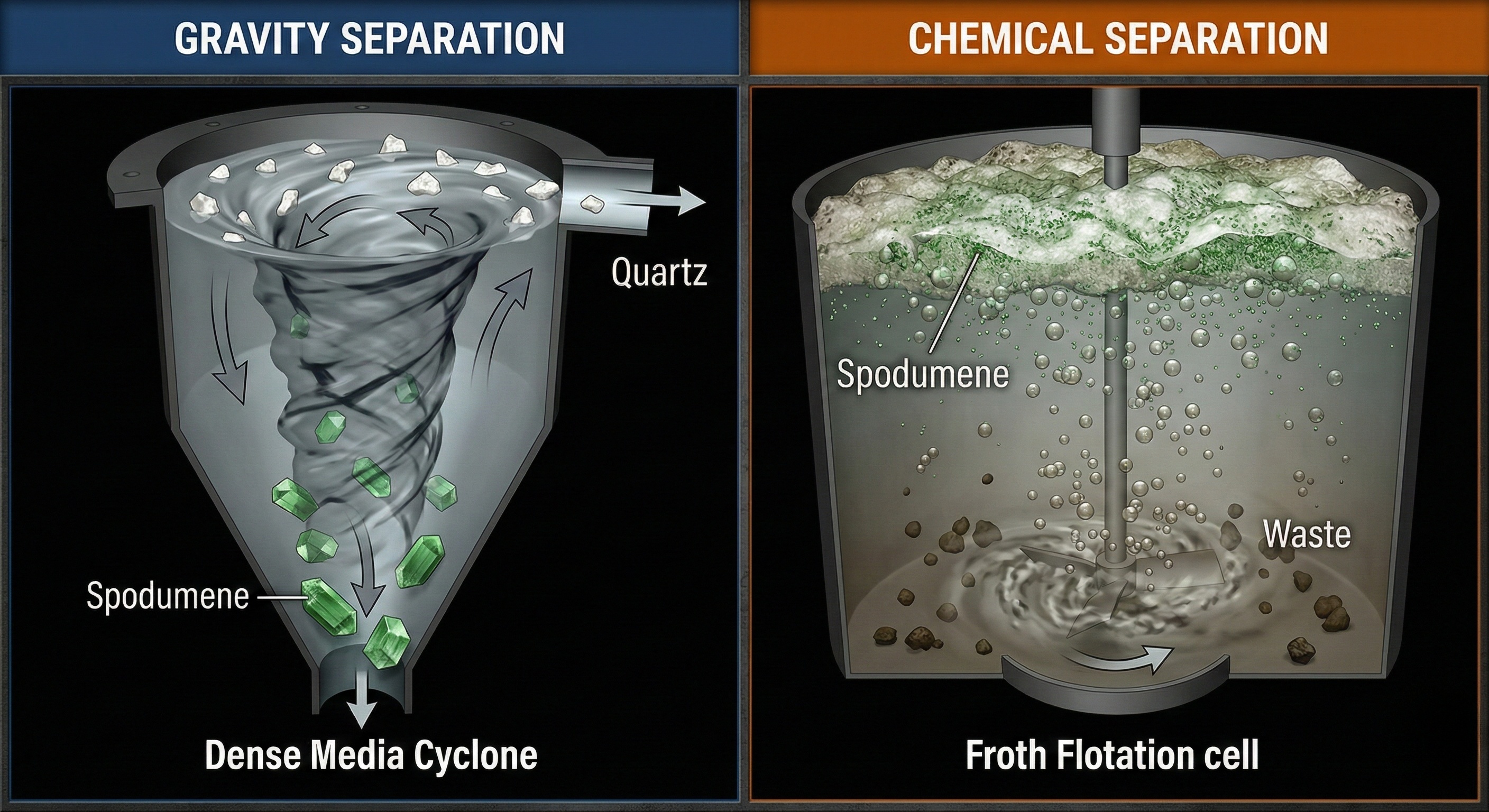
DMS is the first line of defense in a spodumene processing plant. It uses a "heavy liquid" (a mix of Ferrosilicon powder and water) to separate minerals based on density. It is strictly for coarse particles (+0.5mm to -10mm).
- The Principle: The Ferrosilicon medium is set to a specific density (e.g., 2.7 - 2.9 SG).
- The Outcome: Spodumene (SG 3.15) sinks. Quartz and Feldspar (SG 2.65) float.
- Why Use DMS? It is cheap, uses no chemicals, and removes 30-50% of the waste rock early, reducing the load on the expensive flotation circuit downstream.
Step 3: Lithium Flotation Process (The Core Technology)
For fine particles (-0.5mm) that are too small for DMS, the lithium flotation process is the only viable solution. This is the most complex part of the plant and determines whether you can achieve SC6.0 grade.
Desliming: The Critical Pre-requisite
Before flotation, the slurry MUST be deslimed. "Slimes" (ultra-fine particles <20 microns) coat the Spodumene surfaces, preventing flotation collectors from attaching. Without a high-efficiency Desliming Hopper or Cyclone cluster, reagent consumption will skyrocket, and grade will plummet.
Flotation Reagents & Cells
Spodumene flotation typically uses Anionic Collectors (Fatty Acids) in an alkaline environment (pH 8-9). The process usually involves:
- Rougher Flotation: Recovering as much lithium as possible.
- Cleaner Flotation (2-3 stages): Re-floating the concentrate to reject entrained gangue and reach SC6.0 grade.
- Scavenger Flotation: Processing the tails to catch any missed lithium.
We recommend using Air-Inflated Flotation Machines for their superior selectivity and ability to handle coarse particles better than mechanical cells.
The Hybrid Solution: Most modern, high-efficiency plants use a Hybrid Flowsheet. They use DMS to recover coarse crystals cheaply at the start, and then grind the DMS tailings to feed the flotation circuit. This maximizes overall recovery.
Step 4: Magnetic Separation & Iron Removal
Iron is the enemy of lithium batteries. Even a perfect flotation concentrate is worthless if it contains high iron. Iron sources include:
- Natural Minerals: Tourmaline, Hematite, Garnet.
- Tramp Iron: Wear metal from crushers and ball mills.
Since Spodumene is non-magnetic, we pass the final concentrate through a Wet Strong Magnetic Separator (High Gradient Magnetic Separator - HGMS). This machine uses a powerful magnetic field (up to 1.5 Tesla) to capture paramagnetic impurities like Tourmaline, ensuring the final product meets the "Low Iron" premium standard.
Spodumene vs Lepidolite Processing: What's the Difference?
Investors often confuse Spodumene with Lepidolite (Lithium Mica). While both are hard rock lithium sources, their processing is different:
- Spodumene: Hard silicate. Processed via DMS and Flotation. High grade (SC6).
- Lepidolite: Soft mica mineral. Often processed using only Flotation (DMS is ineffective due to its flakey shape). Typically produces a lower concentrate grade (2.5% - 3.5% Li2O) but is easier to mine.
OreSolution provides customized flowsheets for both mineral types.
FAQ: Common Questions on Lithium Processing Plants
A: A well-optimized plant typically achieves a global recovery of 75% to 80%. Pure DMS plants may only achieve 60-65%, while fully integrated Flotation plants can reach 85%. Achieving >80% recovery while maintaining SC6.0 grade is the mark of a top-tier operation.
A: "Slimes" are ultra-fine mud particles. They coat the Spodumene surfaces, preventing the flotation chemicals from attaching. Without thorough desliming using a Desliming Hopper, reagent consumption will skyrocket, and recovery will plummet.
A: No. Magnetic separation removes iron impurities (purification), but it cannot separate Spodumene from Quartz/Feldspar (concentration). You need Gravity (DMS) or Flotation for the main separation, and Magnetic Separation for the final polishing.
Conclusion
Processing Hard Rock Lithium is a balancing act between maximizing recovery and minimizing iron content. Whether you choose a simple DMS plant for a quick start-up or a fully integrated lithium flotation process for maximum yield depends on your ore mineralogy and budget.
At OreSolution, we provide end-to-end Lithium Ore Production Line solutions, from lab metallurgical testing to EPC plant construction. Don't leave your "White Gold" in the tailings dam.
Ready to build your Lithium Plant? Contact us today for a feasibility study and process design.