


Graphite Ore Processing Plant: The Ultimate Guide to Flake Graphite Beneficiation
Driven by the electric vehicle (EV) revolution, natural graphite has officially entered the list of global critical minerals. A lithium-ion battery actually contains more graphite (in its anode) than lithium. This insatiable demand has triggered a massive wave of investment in graphite ore processing plants globally, particularly in Africa and the Americas.
However, processing natural Flake Graphite is notoriously one of the most paradoxical and complex engineering challenges in metallurgy. Why? Because the market pays a massive premium for large flake sizes. Yet, to achieve the required high purity (95%+ Fixed Carbon), you must grind the ore to remove impurities. If you grind too aggressively, you destroy the valuable large flakes, turning a premium product into low-value dust.
As a premier EPC (Engineering, Procurement, and Construction) contractor, OreSolution specializes in designing highly customized Graphite Ore Production Lines. This comprehensive guide will dissect the "Multi-Stage Grinding, Multi-Stage Flotation" process, the unique reagent chemistry, and how to design a flowsheet that protects your flake size while maximizing purity.
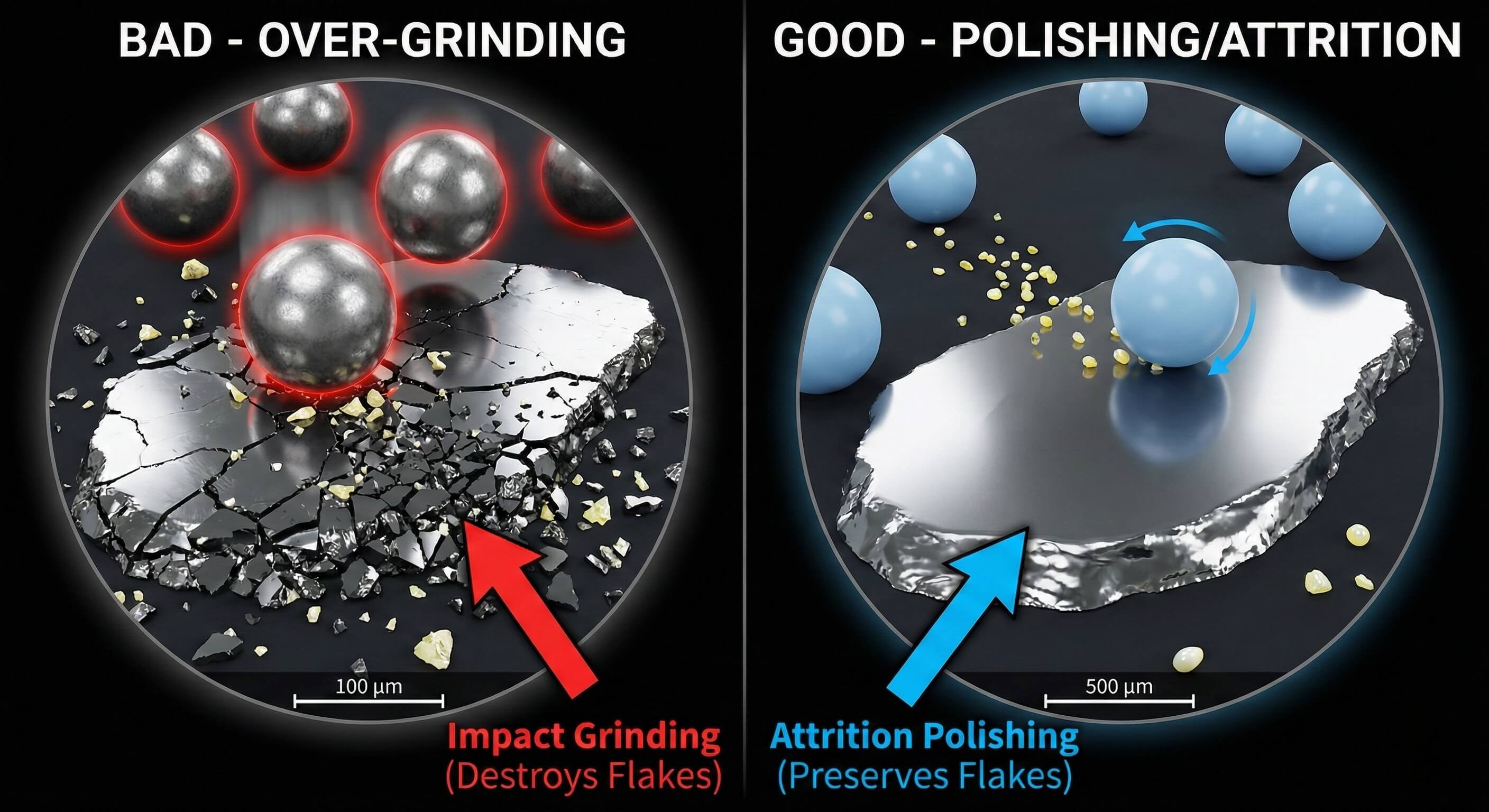
In a graphite flotation process, grinding increases Purity but destroys Flake Size. The entire design of a modern graphite plant revolves around solving this paradox using gentle attrition, stage-grinding, and highly selective flotation circuits.
Part 1: Understanding Flake Graphite Economics
Before buying crushers or flotation cells, you must understand how your final product is priced. Unlike gold, which is priced purely by weight and purity, flake graphite beneficiation products are priced based on two metrics: Fixed Carbon (FC) % and Flake Size (Mesh).
*The goal of any graphite ore processing plant is to maximize the yield of +80 mesh and +50 mesh flakes while achieving >94% Fixed Carbon.
Part 2: Comminution - The Art of Gentle Crushing
The primary ore (typically containing 3% to 15% Carbon) must be crushed and ground. But because graphite is incredibly soft (1-2 on the Mohs scale) and naturally lubricating, standard grinding methods used for copper or gold will pulverize it.
1. Crushing Circuit
Standard Jaw Crushers and Cone Crushers are used to reduce the Run-of-Mine (ROM) ore to around -15mm to -20mm. This stage does not damage the flakes because the crushing forces act on the harder gangue (waste) rock.
2. Primary Grinding: Why Rod Mills Win
For primary grinding, we strongly recommend a Rod Mill instead of a standard Ball Mill.
- Ball Mills use point-contact crushing, causing severe over-grinding and destroying large flakes.
- Rod Mills use line-contact crushing. They act almost like a rolling pin, crushing the harder quartz while gently "sliding" over the slippery graphite flakes, preserving their size.
The goal of primary grinding is not complete liberation, but just enough liberation to get the ore into the first rougher flotation cell.
Part 3: The Graphite Flotation Process
Graphite is naturally hydrophobic (water-repelling). This means it floats extremely easily. You don't need complex, expensive collectors like you do for sulfide ores. The challenge isn't getting graphite to float; the challenge is preventing gangue minerals (like mica and quartz) from floating with it.
Reagent Chemistry
The "Multi-Stage" Flowsheet Architecture
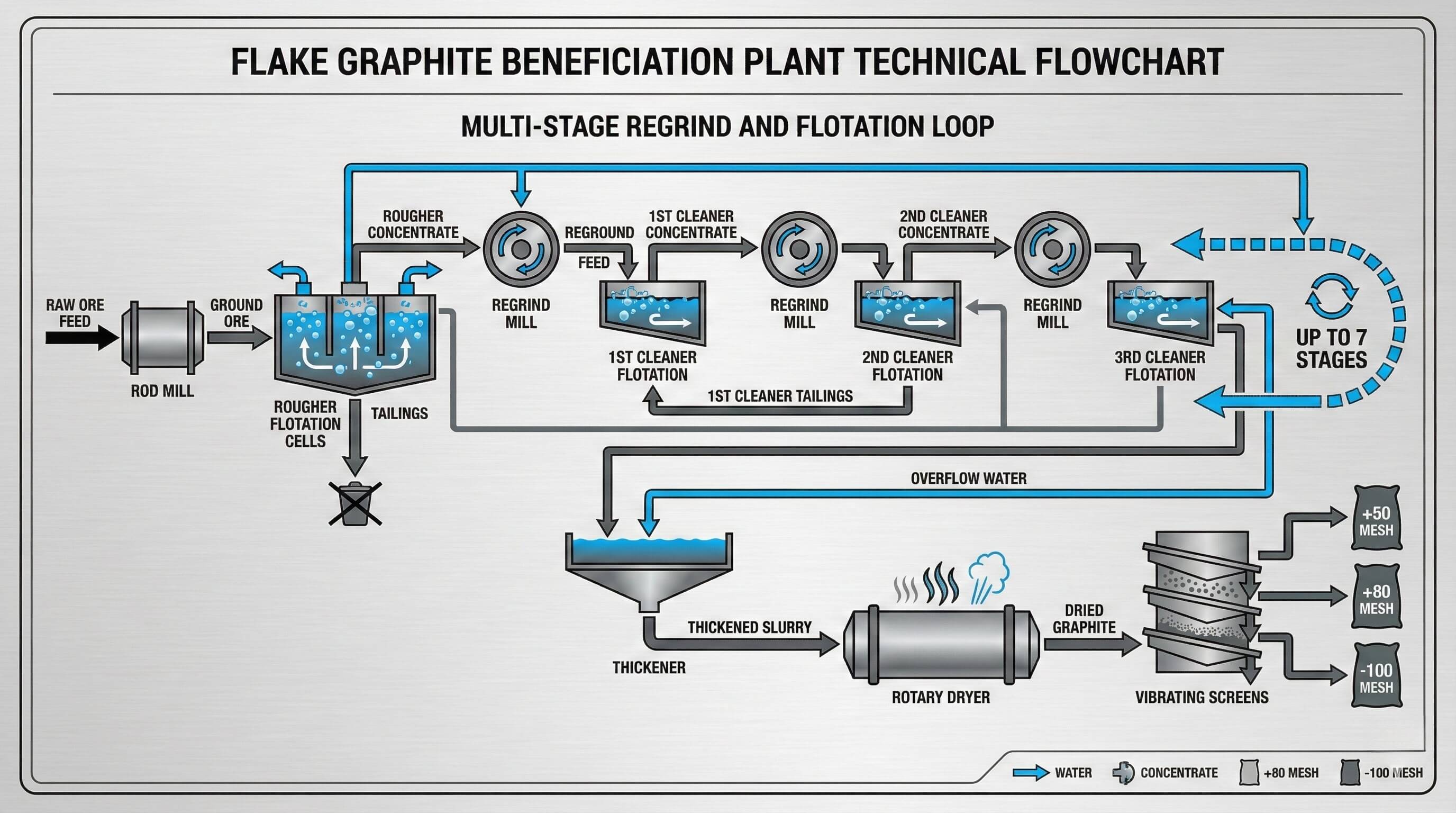
Because we cannot grind the ore to a fine powder in one step, a modern flake graphite beneficiation plant uses a looping sequence of: Float → Regrind → Clean → Repeat.
- Rougher Flotation: The coarsely ground ore enters the rougher cells. We float as much graphite as possible quickly. The concentrate is low grade (perhaps 40-50% FC), but recovery is high. Tailings go to Scavenger cells.
- First Regrind: The rougher concentrate is sent to a specialized regrind mill (often a Stirred Mill, Vertimill, or a Ball Mill with light, ceramic media). The goal here is "polishing"—gently rubbing the attached quartz off the graphite flakes without breaking the flakes in half.
- First Cleaning: The reground slurry goes to cleaner flotation cells. The grade increases.
- The Loop (3 to 9 Stages!): The concentrate is reground again, and cleaned again. A typical high-end plant designed by OreSolution may feature 1 rougher stage, 1 scavenger stage, and up to 5 to 9 cleaner stages with intermediate regrinding. This extreme repetition is the only way to slowly detach impurities while protecting the flake structure.
Part 4: Dewatering, Drying, and Classification
Once the final concentrate reaches >94% Fixed Carbon in the final cleaner cell, it is in a wet slurry form. It must be dried and sorted into commercial products.
1. Dewatering
The graphite froth is very voluminous. It is first pumped to a High-Efficiency Thickener to remove the bulk of the water. The thickened underflow is then processed by a Filter Press or Vacuum Filter to create a moist filter cake (about 15-20% moisture).
2. Drying
The filter cake is fed into a Rotary Dryer. Because graphite is highly heat-resistant, it can be dried efficiently using direct hot air, bringing moisture down to less than 1%.
3. Screening and Bagging (The Final Value Add)
You do not sell graphite as one massive pile. You must separate it into the mesh sizes (+50, +80, +100, -100) listed in Part 1. This is done using highly precise Linear Vibrating Screens equipped with fine mesh cloth. Each size fraction is then packaged into 1-ton bulk bags and sold at different price points.
FAQ: Expert Troubleshooting for Graphite Plants
A: A plateau in purity usually means impurities (like quartz or mica) are physically locked inside the graphite flakes (intercalated). Adding more flotation chemicals won't help. You must increase the intensity or duration of your intermediate regrinding stages to physically polish these impurities off before the final cleaner cells.
A: You are suffering from "over-grinding". Your regrind mills are breaking the flakes. To fix this, switch from heavy steel balls to light ceramic media in your regrind mills, reduce the mill RPM, or switch to specialized Stirred Mills that rely on attrition (rubbing) rather than impact (smashing).
A: Graphite froth is naturally very stable and highly mineralized, making it viscous. If you overdose Kerosene (collector) or Pine Oil (frother), the froth becomes unmanageable. Optimize your reagent dosing, and ensure your froth launders (the overflow troughs) are designed with a steep angle and adequate spray water to break down the bubbles.
A: No. Mechanical flake graphite beneficiation (flotation) hits a physical limit around 95% to 97% FC. To reach the 99.9% / 99.95% required for spherical battery anodes, the 95% concentrate must undergo secondary chemical purification, typically involving hydrofluoric (HF) acid leaching or alkaline roasting.
Conclusion: The EPC Engineering Advantage
Designing a graphite ore processing plant is arguably the most delicate balancing act in mineral processing. It requires a profound understanding of flotation kinetics, milling media, and continuous classification. A generic plant design will inevitably crush your large flakes, instantly destroying the economic viability of your project.
At OreSolution, we treat graphite processing as an art form backed by hard data. From core sample metallurgical testing to flowsheet optimization and final EPC plant delivery, we design Graphite Production Lines that protect your flake size while hitting your target purity.
Are you developing a flake graphite deposit? Contact OreSolution today. Let our expert engineers design a flowsheet that maximizes your premium jumbo flake yield.