


Kaolin Washing Plant: The Ultimate Guide to Processing & Whitening China Clay
Kaolin, universally known as "China Clay," is a soft, earthy, usually white mineral produced by the chemical weathering of aluminum silicate minerals like feldspar. While often associated with the ceramics industry, the true value of high-grade kaolin lies in its use as a premium coating and filler in the paper, paint, rubber, and cosmetics industries.
However, raw kaolin mined from the earth is rarely pure white. It is typically contaminated with coarse quartz sand, mica, and most critically, coloring impurities like iron oxides (rust) and titanium dioxide. The difference between a low-value brick-making clay and a high-value paper-coating pigment is entirely determined by the sophistication of the kaolin washing plant.
As a leading EPC (Engineering, Procurement, and Construction) contractor, OreSolution has engineered cutting-edge Washed Kaolin Production Lines around the globe. This comprehensive engineering guide details the transformation of raw run-of-mine clay into an ultra-fine, ultra-white commercial product, focusing on the critical stages of pulping, micro-classification, magnetic whitening, and high-pressure dewatering.
In the kaolin industry, pricing is dictated by two absolute metrics: Whiteness (Brightness) and Particle Size Distribution (Fineness). A plant designed simply to "wash" the clay without advanced ultrafine classification (using specialized cyclones) or iron removal (using superconducting magnets or chemical bleaching) will fail to produce premium grades, leaving millions of dollars on the table.
Part 1: Defining the Target - Commercial Applications of Kaolin
Before designing a kaolin processing flowchart, you must identify your target market. Different industries demand vastly different physical and optical properties from the clay.
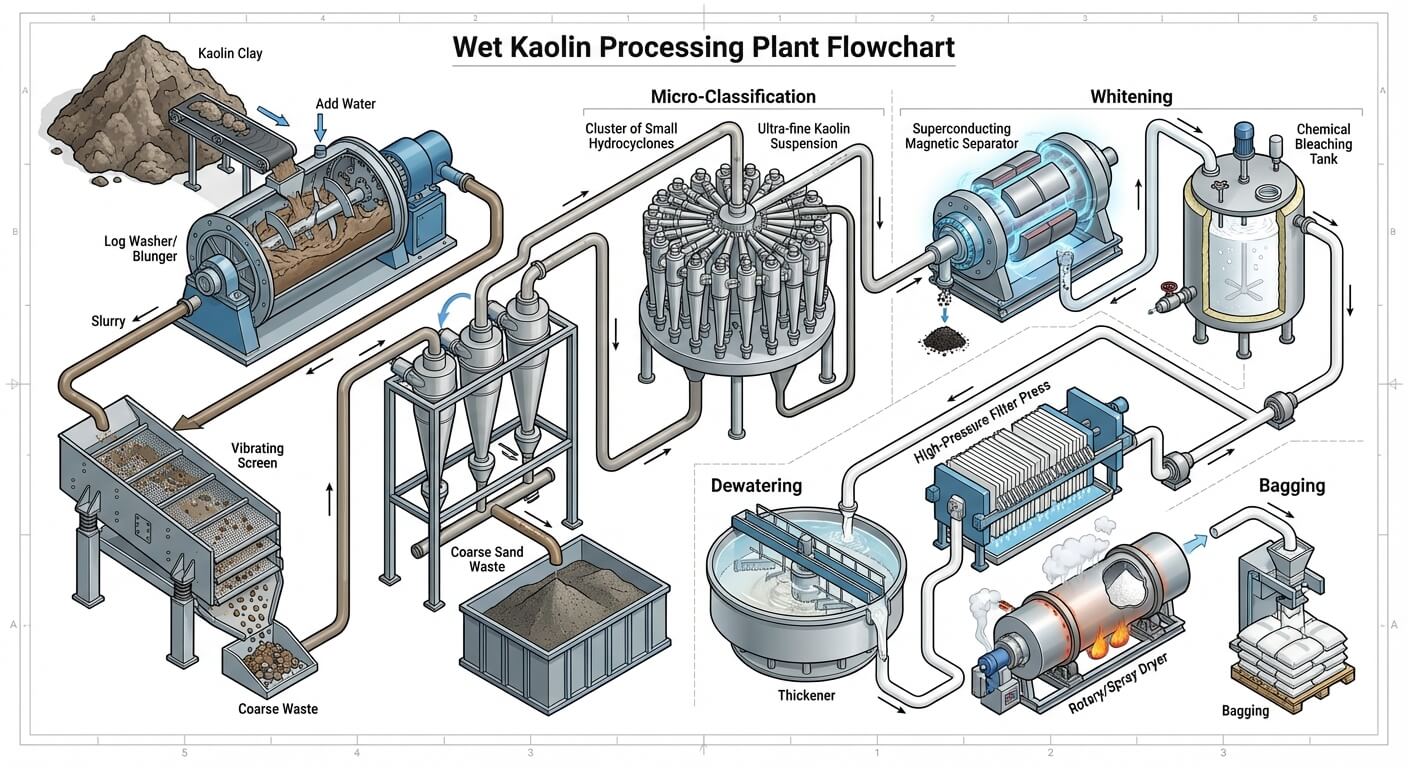
Part 2: The Wet Processing Flowchart - Step by Step
While dry processing is possible for very pure deposits (typically just crushing and air-classification for low-end uses), the vast majority of commercial kaolin undergoes Wet Processing (Washing) to achieve high purity.
Stage 1: Pulping and Disaggregation (Making the Slurry)
The raw clay cannot be crushed like hard rock. Instead, it must be "pulped" (mixed with water) to break apart the clay matrix and release the individual kaolin platelets from the sand and rock.
- Raw ore is fed into a heavy-duty Log Washer or a high-shear Blunger (Pulping Machine).
- Water and dispersing agents (like sodium silicate or polyacrylates) are added. The goal is to create a homogenous slurry (typically 30-40% solids) where the clay particles are fully suspended and detached from the coarse quartz sand.
Stage 2: Degritting (Removing the Sand)
The pulped slurry contains significant amounts of coarse quartz, mica, and un-weathered feldspar, collectively known as "grit." This must be removed immediately to protect downstream equipment.
- Coarse Degritting: The slurry passes over a Linear Vibrating Screen (e.g., 60 to 100 mesh) to scalp off roots, large gravel, and coarse sand.
- Fine Degritting: The undersize from the screen is pumped through a primary cluster of large Hydrocyclones. The heavy sand exits the bottom (underflow) and is sent to a Spiral Washing Machine or dewatering screen to be sold as a byproduct (construction sand). The fine kaolin suspension overflows from the top.
Stage 3: Micro-Classification (Defining the Particle Size)
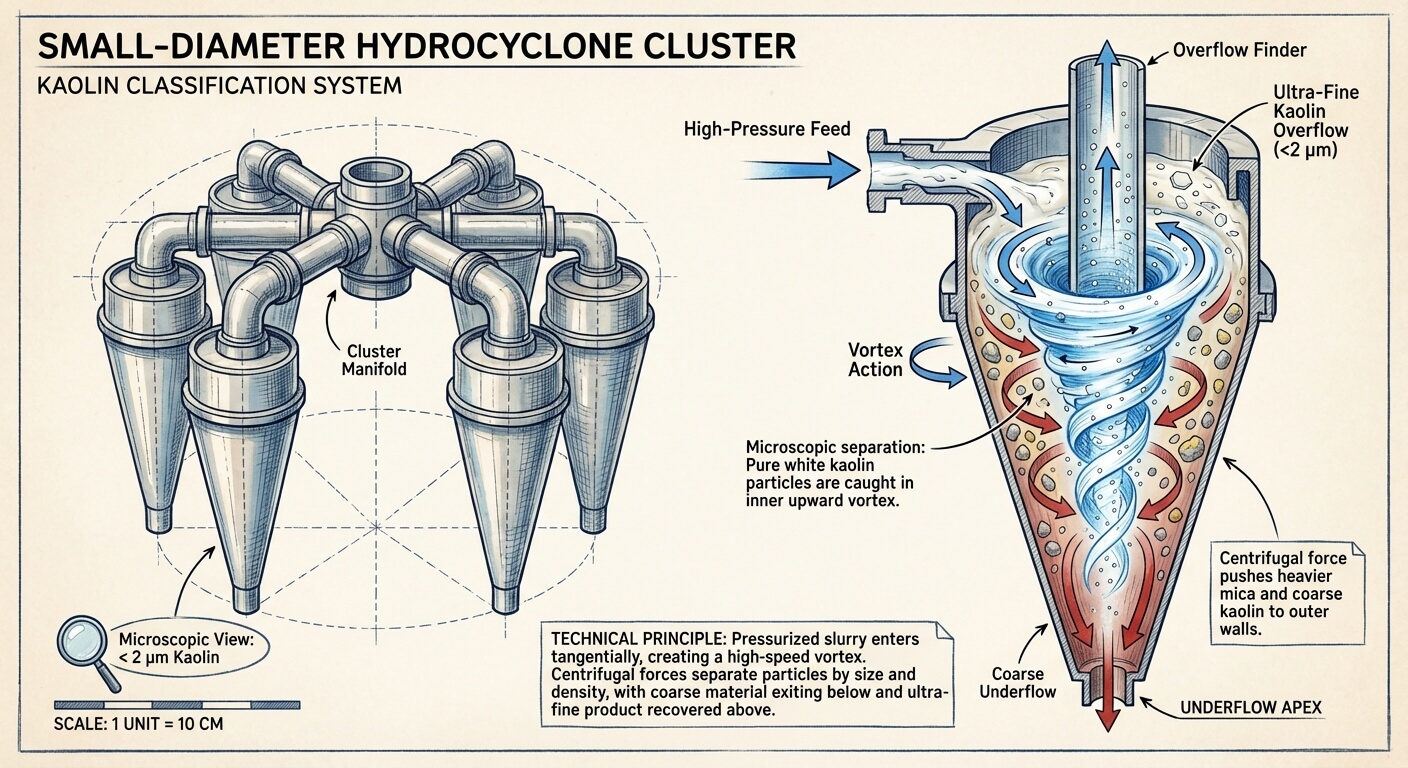
This is where the true value of the kaolin is unlocked. Premium paper-grade kaolin requires up to 90% of the particles to be smaller than 2 microns.
To achieve this microscopic cut, OreSolution employs Multi-Stage Small-Diameter Hydrocyclones. These are highly specialized polyurethane cyclones (often only 50mm or 75mm in diameter) operating at high pressure. The slurry is pumped through multiple stages of these micro-cyclones, precisely separating the ultra-fine kaolin (overflow) from the slightly coarser kaolin and fine mica (underflow).
Part 4: The Whitening Process - Removing Iron and Titanium
Even after removing the sand, the fine kaolin slurry may still appear yellowish or reddish due to microscopic iron (Fe2O3) and titanium (TiO2) impurities. To reach the coveted 85%+ brightness, aggressive whitening techniques must be employed.
Part 5: Delamination - Engineering the Platelets
Natural kaolin particles exist as "booklets"—stacks of flat, hexagonal plates. For applications like paper coating, these booklets must be peeled apart into individual, flat plates to increase gloss and opacity. This process is called Delamination.
Delamination is achieved using specialized attrition mills (Stirred Media Mills) filled with fine ceramic or glass beads. The intense shearing action gently slides the kaolin plates apart without breaking them horizontally.
Part 6: Dewatering and Drying (The Energy Bottleneck)
By the time the kaolin reaches the end of the purification circuit, it is a highly dilute slurry (often 10-15% solids). Because kaolin particles are microscopic and flat, they hold onto water tenaciously. Removing this water efficiently is the most challenging mechanical aspect of the kaolin washing plant.
- Flocculation and Thickening: The slurry pH is adjusted to coagulate the clay. It is pumped into a massive High-Efficiency Thickener. The clay settles to the bottom, thickening to about 30% solids, while clear water overflows for recycling.
- High-Pressure Filtration: The thickened slurry must be pressed into a cake. Due to the ultra-fine nature of the clay, standard filtration fails. We utilize high-pressure, fully automated Plate and Frame Filter Presses or advanced Tube Presses. This squeezes the moisture down to 25-30%, creating solid "kaolin cakes."
- Drying: The filter cakes are extruded into noodles or crushed, and then fed into a Rotary Dryer or a Flash/Spray Dryer. The final product is a dry powder (moisture <1%), ready for bagging or bulk transport.
FAQ: Troubleshooting Kaolin Processing Plants
A: Kaolin slurries are highly thixotropic (they become thick and gel-like when resting). If you over-thicken the slurry without adding sufficient dispersants (deflocculants) like sodium polyacrylate, it will turn into a solid paste in your pipes. Proper rheology control via chemical dosing is essential before pumping to the filter press.
A: You can, but it is often economically unsustainable for high-iron ores. Chemical bleaching consumes expensive reagents (Hydrosulfite) proportionally to the amount of iron present. By using a High-Gradient Magnetic Separator first, you remove the bulk of the iron mechanically, drastically reducing your ongoing chemical bleaching costs.
A: Ultra-fine kaolin (<2 microns) will rapidly blind standard filter cloths. Ensure you are using the correct micron-rated multifilament/monofilament filter cloths. Additionally, your feed pressure might be too low. High-quality kaolin filtration often requires feed pressures exceeding 15 Bar (220 PSI) to force the water out of the fine platelet structure.
Conclusion: The EPC Engineering Advantage
Transforming raw, sandy clay into a brilliant white, ultra-fine industrial pigment is an exercise in microscopic precision. A poorly designed kaolin washing plant will struggle with sand contamination, fail to reach the target brightness, and face catastrophic bottlenecks in the dewatering stage.
At OreSolution, we approach kaolin processing with a holistic EPC methodology. From initial rheology and whiteness testing in our laboratory, to designing the complex micro-cyclone circuits, and commissioning the high-pressure filtration systems, we ensure your Washed Kaolin Production Line operates continuously and profitably.
Are you looking to upgrade your kaolin deposit? Contact OreSolution today to consult with our industrial mineral specialists and begin designing your high-purity washing plant.