


IBA Processing Plant Guide: How to Recover Metal from Incineration Bottom Ash
Every year, the world burns millions of tons of municipal waste in Waste-to-Energy (WtE) plants. What remains is a grey, ash-like substance called Incineration Bottom Ash (IBA). For decades, this was landfilled as waste. But today, smart investors recognize IBA for what it truly is: a rich "Urban Mine" loaded with Copper, Aluminum, Gold, and Silver.
Unlike natural mining where ore grades are declining, the metal content in IBA is surprisingly high—often richer than many active mines. However, extracting these metals requires specialized IBA processing plant technology. Standard crushing isn't enough; you need precise gravity separation to handle the complex mix of wet ash, slag, and metals.
As a leader in Eco-Mining EPC solutions, OreSolution provides the Total Solution for Metal Separation from Incineration Bottom Ash. This guide explores the economics, the mineralogy, and the optimal equipment—specifically focusing on why Jig Separators are the secret weapon for high recovery.
A single ton of IBA can contain up to 10-15% ferrous metals and 2-5% non-ferrous metals (Copper/Aluminum). Additionally, the remaining "clean ash" can be sold as construction aggregate. This is a dual-revenue business model: selling metals + selling aggregate.

What is Incineration Bottom Ash (IBA)?
IBA is the non-combustible residue from waste incineration. Before designing an IBA processing plant, we must understand its composition. It is a heterogeneous mix, unlike consistent natural ores.
The Challenges of IBA Recycling
Processing IBA is not like processing granite. It has unique challenges:
- High Moisture: IBA comes out of the incinerator wet (quenching). This makes dry screening difficult (blinding screens).
- Complex Interlocking: Metals are often fused with slag or glass. Liberation is required but over-crushing can flatten malleable metals (like aluminum) instead of breaking them.
- Wide Particle Size: Valuable metals range from large chunks (+50mm) to fine dust (-1mm).
The IBA Processing Flowchart: Step-by-Step
A modern incineration bottom ash recycling plant involves a combination of screening, magnetic separation, and advanced gravity separation. Here is the OreSolution standard flowsheet:
Step 1: Aging (Weathering)
Fresh IBA is chemically unstable. It is typically stockpiled for 6-12 weeks. This allows oxidation, stabilizes pH, and reduces moisture content naturally, making downstream processing easier.
Step 2: Screening & Size Classification
We use a Trommel Screen to separate the material into fractions (e.g., 0-10mm, 10-50mm, +50mm). Large items are removed manually or mechanically. Sizing is critical because gravity separators work best on narrow size ranges.
Step 3: Magnetic Separation (Ferrous Recovery)
This is the easiest step. Overhead suspension magnets or Magnetic Separators pull out iron and steel scrap. This protects downstream crushers and generates immediate revenue.
Step 4: Gravity Separation (The Core Technology)
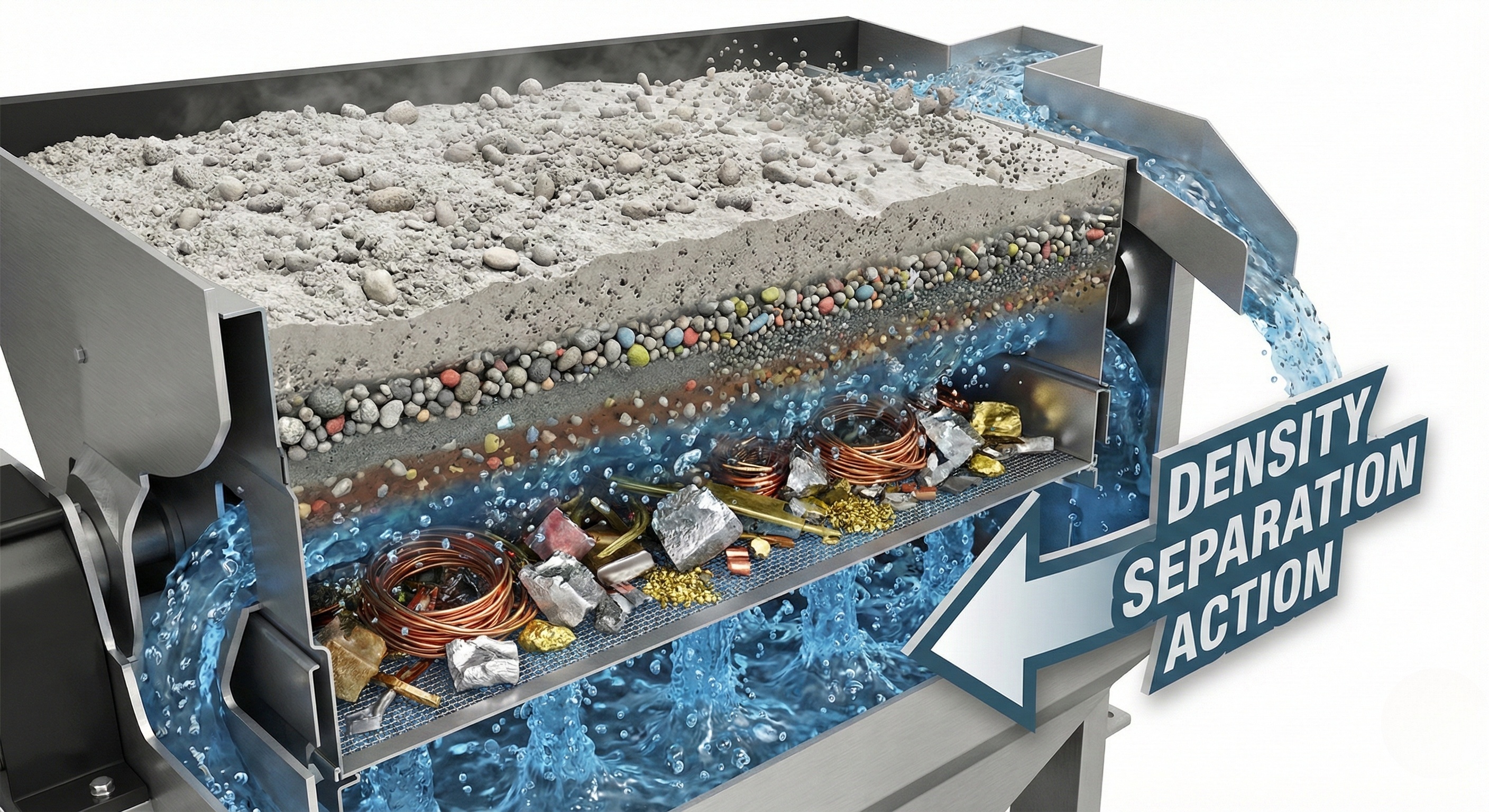
This is where OreSolution excels. To separate heavy non-ferrous metals (Copper SG 8.9, Gold SG 19.3) from light slag/ash (SG 2.5), we use Jigging Technology.
The Sawtooth Wave Jig is superior to traditional air separation or simple washing. It uses a pulsating water column to stratify the material. Heavy metals sink, while light ash floats.
- Efficiency: Recovers metals down to 2mm.
- Cost: Much cheaper than Eddy Current Separators for the coarse/medium fraction.
- Result: Produces a heavy concentrate (mixed metals) and clean light aggregate.
Jig Separator vs Eddy Current Separator
Many European plants rely heavily on Eddy Current Separators (ECS). While ECS is great for Aluminum, it struggles with wet, fine, or heavy metals like Copper/Lead. OreSolution advocates for a Jig-First approach.
Our Strategy: Use Jigs to recover the bulk of heavy metals and clean the aggregate. Use ECS only as a final polishing step for Aluminum if needed.
Step 5: Fine Metal Recovery (The "Hidden Gold")
Fine ash (-2mm) often contains precious metals (Gold, Silver) and fine Copper wires. These are missed by magnets and ECS. For this fraction, we employ Shaking Tables.
The Shaking Table effectively separates fine heavy metals from fine ash, often producing a high-value concentrate that can be sold directly to smelters. This step alone can significantly boost the plant's ROI.
Profitability: The Economics of Urban Mining
Why invest in an IBA processing plant? The economics are driven by three factors:
- Gate Fees: In many countries, incinerators pay you to take the ash away (tipping fee).
- Metal Sales: Copper and Aluminum scrap prices are historically high. Recovering just 1% copper translates to massive revenue.
- Aggregate Sales: Cleaned ash (IBA Aggregate) meets construction standards for road sub-base, turning a disposal cost into a sales product.
FAQ: IBA Processing Technical Questions
A: Yes, if you use Gravity Separation. Our Sawtooth Wave Jig is a wet process, so it handles the natural moisture of IBA perfectly. Dry processing plants require expensive drying, which consumes huge amounts of energy.
A: The water used in the jigging process is recycled via a Thickener. The settled sludge is pressed into dry cakes using a Filter Press and can be safely landfilled or used in cement manufacturing.
A: A typical IBA plant is compact. A 50 TPH line including storage, screening, and jigging modules typically requires a footprint of approximately 2,000 - 3,000 square meters.
Conclusion
Incineration Bottom Ash is not waste; it is a resource waiting to be unlocked. By shifting from simple magnetic separation to advanced Gravity Separation (Jigging), you can recover the valuable heavy metals that others miss.
At OreSolution, we help municipalities and private investors turn environmental liability into profit. From process design to equipment installation, we are your partner in Urban Mining.
Turn your ash into cash. Contact us today for a free IBA recycling consultation.